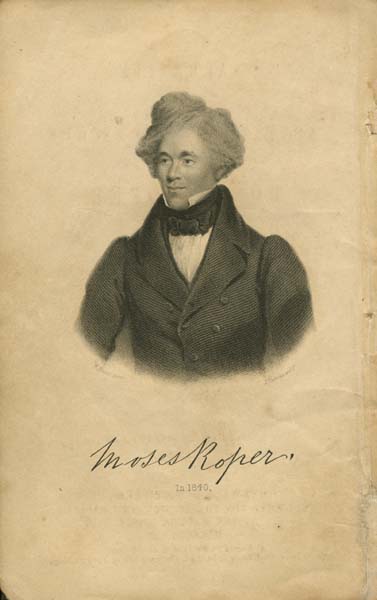
Moses Roper was born into slavery in Caswell County, North Carolina, the son of a slaveholder and one of his slaves, sometime in the years around 1820. By 1835, he had endured a childhood sold away from his mother, over a dozen owners, and brutal punishments and torture that people would later find difficult to believe. He kept attempting to escape until he succeeded, but even when he was resettled in rural New England, he did not feel safe, and sympathetic abolitionists in Boston and New York helped him reach the safety of England. There, he got an education and quickly became involved in British and Irish abolitionism, which was turning its attention from the West Indies to the United States. Roper wrote an autobiography and began lecturing widely, becoming the first fugitive slave to speak in Ireland and one of the first in Britain. But when in 1839 Roper married a white Welsh woman and began reconsidering his plan to become a missionary in Africa, he lost crucial support from influential abolitionists. In a few years, he had moved his family to Canada, and in the late 1840s and 1850s, Roper returned to Britain and Ireland to publish further editions of his narrative and to lecture. In 1859, Roper's wife and children moved to Wales to live with her father, and Roper's last confirmed presence in Britain is in 1861. At that point, he vanishes for two decades, reappearing in New England in the early 1880s, before dying in Boston in 1891.
Roper's narrative is well known to historians and literary scholars, but his life (and the various editions of his narrative) have not yet received careful attention. We are in the process of tracing the entirety of Roper's life, piecing together the background for what he describes in his autobiography, and then following his bold, tumultuous, and ultimately lonely life in the decades after. Unlike celebrity abolitionists such as Frederick Douglass, Roper did not maintain a public presence over decades. Yet, he set the pattern for many of the fugitive slave abolitionists who would come after him to draw support for the cause in Ireland and Britain. We have much to learn from Roper's life, and it is quite a story. We welcome you to follow along on this journey as we discover and share more about what Roper described as the "remote places" he visited as he tried to save others from suffering as he had.
